The short answer
A good Meta Ads naming convention uses dashes instead of spaces, lowercase except abbreviations, and YYMMDD dates. Name campaigns as [Brand]-[Funnel]-[Location]-[Language]-[Objective]-[Description], ad sets by audience details, and ads by date, asset type and message, so anyone can understand an item from its name alone.
Before you start
By the end of this SOP
Simple rules for naming campaigns, ad sets, ads and audiences.
- Time
- 30–60 minutes
- You’ll need
- Your account structure (SOP 069).
- Who does this
- The person responsible for Meta ads or marketing strategy.
About this SOP: why it matters, where and when
Why it matters: Clear names make control and reporting faster for everyone on the account.
Where: A text document or the Unlearn Naming Convention Generator sheet.
When: When you start on an ad account without a naming convention.
Stage 1
Before you start
- 1
Using dynamic URL parameters? Your names can show up in the URL, so never put anything private in a name.
- 2
Fit the names to your structure, not the other way round. Get the structure right first with SOP 069.
- 3
Make a copy of the Unlearn Naming Convention Generator sheet to follow along.
Stage 2
Follow the 3 golden rules
- 1
Use dashes instead of spaces.
- Good: unlearn-TOFU-IN-EN-reach-branding
- Bad: unlearn TOFU IN EN reach branding
- 2
Use lowercase, except for abbreviations like IN, EN, TOFU.
- 3
Write dates as YYMMDD so they sort correctly.
- Good: 261020-VID-demo-class
- Bad: 20-10-26-VID-demo-class
Stage 3
Name each level
Use what makes each item unique, from broad to specific.
- 1
Campaign: [Brand]-[Funnel]-[Location]-[Language]-[Objective]-[Description]
- unlearn-TOFU-IN-EN-reach-dm-course
- unlearn-MOFU-IN-ML-leads-free-demo
- 2
Ad set: [Audience type]-[Language]-[Location]-[Audience]. Add [Placement] only if you really chose placements by hand (most ad sets use Advantage+ placements).
- BROAD-ML-KL-advantage-audience
- RM-EN-KL-fee-page-30d
- 3
Ad: [YYMMDD]-[Asset type]-[Idea]-[Variant]
- 261020-VID-student-story-anjali-v1
Watch out
Avoid outcome promises like “get-hired-in-4-months” even in names. Names can appear in URLs and reports, and the same claim in the ad would break Meta’s policy on misleading claims.
- 4
Custom audience: [Source]-[Audience]-[Location]-[Days]
Note
Long audience names get cut off in Ads Manager. Put the most important details first in the name, not only in the description.
- 5
Here is where names show up in Ads Manager. Mixed styles like these (spaces, slashes, different date formats) are exactly what a naming convention fixes.
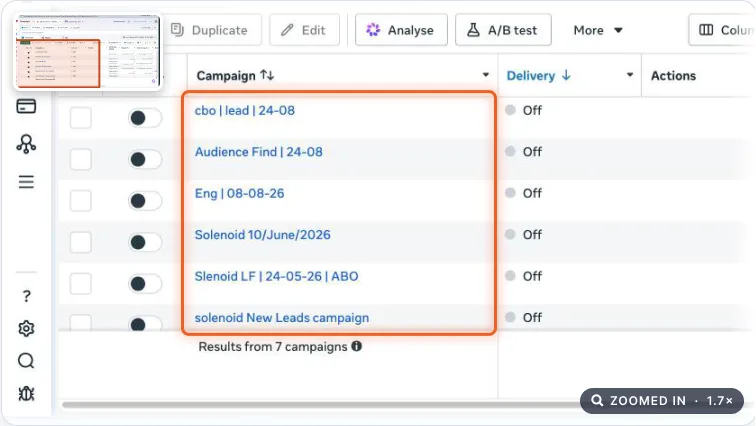
Ads Manager campaign list showing campaign names in mixed styles. Real screenshot, Oct 2026.
Stage 4
Use standard abbreviations
- 1
Countries IN, AE, GB · regions KL (Kerala), TVM, KOC · languages EN, ML · currencies INR, AED.
- 2
Marketing short forms: RM remarketing (showing ads again to people who already visited or engaged) · BROAD broad / Advantage+ audience · LA lookalike · WC website conversions · ATC add to cart · LPV landing page views · FB / IG · TOFU / MOFU / BOFU (top, middle, bottom of funnel) · IMG / VID.
- 3
Use the names in your tracking links too. In the ad’s URL parameters, add utm_campaign={{campaign.name}}&utm_content={{ad.name}}. GA4 then shows your clean names automatically.
Tip
This is the real reason naming matters: one consistent name lets you match Meta, GA4 and your CRM lead sheet line by line.
- 4
Final check: does each name tell you what the item is about at a glance? If not, refine and try again.
Agency playbook
Doing this for a paying client
What a senior checks before calling the job done. Numbers are starting rules; compare them with the account’s own history.
What good looks like
- A new team member can tell objective, funnel stage, market, language and audience from the name alone, without opening anything.
- Every live campaign, ad set and ad follows one convention. No “New Leads Campaign – Copy 2” anywhere in the account.
- Names split cleanly into columns in Google Sheets on “-”, so one pivot table groups results by funnel, language or creative type.
- Ads Manager, GA4 (Google Analytics 4) and the client’s lead sheet show the same campaign and ad names, so numbers match line by line.
Mistakes we see on real accounts
- Renaming live campaigns with no log. Last month’s GA4 data shows old names and totals no longer match your report.
- Putting budget in the name, e.g. “-2000-day”. After the first budget change, the name is wrong and misleads everyone.
- One junior writes ML, another MAL for Malayalam. Filters miss half the ads and the language report is wrong.
- Leaving default ad names. You can’t tell which creative won, so the next brief repeats the losing idea.
Agency checklist before you call it done
- The agreed convention and abbreviation list are saved in the client folder, with a version date.
- Every item is renamed before you publish, including “– Copy” duplicates and auto-named ads.
- No names contain phone numbers, customer details, prices you may change, or outcome promises.
- Open one ad’s link from the preview and confirm the UTM (tracking link) values show the clean names. Save the screenshot.
- The same names are used in the planning sheet, Ads Manager and change log.
- Any rename of a live item is logged with old name, new name and date.
- The client’s in-house team has the key, so their own boosted posts follow it too.
Handover message to the client
Hi [Client name], we’ve applied our naming system to your Meta account. Example: “[brand]-BOFU-KL-ML-leads-onam-offer”. Your reports and Google Analytics will now show which ad brought each lead. The full key is in our shared folder: [link].
Senior tip
Give every creative an ID (e.g. C017) in the ad name and in your creative tracker. Then you can see which hook, format or face wins across months and campaigns, not just inside one ad set.
Practice & check
Now do it for real
Reading is not doing. Open your own account and complete this task before you move on.
Practice task (5 min)
Rename three of your campaigns using [Brand]-[Funnel]-[Location]-[Language]-[Objective]-[Description].
Prove it
Two questions. Get both right and this SOP is done.
Common questions
Why use dashes in Meta campaign names?
Dashes make names easy to search (e.g. “-IN-”) and to split into columns in Excel or Google Sheets.
What date format should I use in ad names?
YYMMDD, for example 261020 for 20 October 2026. It sorts correctly and avoids day/month confusion.
Done. That’s a real skill, not a certificate.
Next: SOP 074 — Select Your Meta Ads Targeting →
Want to do this on real client budgets, with a mentor checking your work? That’s Level 2 at Unlearn. See the Digital Marketing track